Showing posts with label mcgregor. Show all posts

August 25, 2018

But, Who Was He?

At the end of the last entry I left off with my astonishment at Nye’s use of a very familiar phrase, “That land from which whose bourne no traveler can return”

As you may know, that’s Hamlet...

Who would fardels bear,
To grunt and sweat under a weary life,
But that the dread of something after death,
The undiscovered country from whose bourn
No traveler returns, puzzles the will
And makes us rather bear those ills we have
Than fly to others that we know not of?

At first, I was sure that this must have just been a common phrase that Nye used. There was no way that the son of a farmer from New Hampshire would be so familiar with the works of Shakespeare to quote them in his diary, right?

That was, until I found a mention of Nye in the History of the Fifteenth Regiment, New Hampshire Volunteers by Charles McGregor. He wrote of Nye:

“His constitution was not a robust one; his spirit, however, carried him through the trying ordeal of the siege of Port Hudson without a break. It is well remembered of him now, while lying in the dark wood in the night, and under the enemy’s guns, he could repeat with the skill of an actor, long sections from Shakespeare and other of the dramatic poets.”

That would explain the Hamlet quote.

I realized then, at this moment when I got a tantalizing look at Nye from an outsider perspective, how little I really knew about his personality.

In his diary he recounts the events that happened to him, but he makes no effort to justify himself to the reader.

During his time at the Seige of Port Hudson, he writes about sleeping “Soundly on the ground in the open field with the Blue Sky for our covering” and how the “Rebells Payed us their respects by sending over sevral shell which exploded in front and Some passed over our heads and Exploded Sevral of our Pickets”

Contemporary Newspaper Print of the Seige of Port Hudson

Yet he fails to mention the very thing he was remembered for, and what, now, draws us in to try and fit the pieces of himself he left behind back together…




August 11, 2018

From NH to NY City Hospital

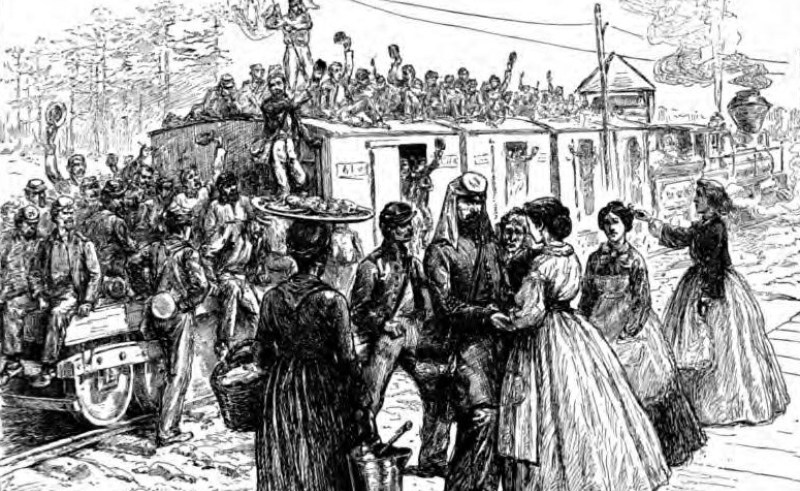
After the 15th New Hampshire regiment mustered in at Concord N.H, they traveled by train down to New York City in order to get transportation to Louisiana. An account of the regiment by Charles McGregor captures the bittersweet feeling of this train journey:

“At all stops people thronged the train, and the boys, not to be outdone, cheered and shouted till they waked the echoes along the route. Many rode on the roofs of the cars, and some lost their caps in the breeze. Mothers wrung their hands, and wept at the parting and in the fearful foreboding of the dark future, and here strangers greet us everywhere with moistened eyes for tears were shed in rivers then as well as blood in those heroic days” (McGregor 143)


A similar scene of a goodbye to Civil War soldiers in Manassas, VA

One can easily imagine the mixture of trepidation and excitement Albert Nye might have been feeling at the sight of all this, especially with the knowledge of leaving a young son and wife at home.

In New York City, the regiment prepared to embark on the ship “James S Green”. But before they left, on December 2nd 1862, Albert was brought from the ship to New York Hospital on account of jaundice.

Jaundice literally means, “yellowing”, and appears as a yellowing of the eyes or skin, and can be caused by a number of different factors. In this case, it was likely due to an infection.

The New York Hospital was located outside of what was then the main city, on Broadway between the current Duane and Worth Streets.

The New York Hospital circa 1882, digitized by the New York Public Library

The hospital where we find Nye at the beginning of his diary is, to this day, the longest running institution of its kind. The New York Hospital, now the New York Presbyterian, was chartered in 1777 of King George III, and officially opened to the public in 1791.

This was radical at a time in which healthcare was primarily for the rich, not publically funded by the state, and often affiliated with churches and religious groups. Prior to 1850, it was the only general hospital in the city, the state, and the country.

It is here that we finally catch up with Nye in the diary, stuck in the hospital, an entire continent away from the rest of his regiment, waiting to be released and scouring the city for anyone who can help him get to New Orleans.

- Ella

Unearthed Accounts

A simple Google search of Nye's name led me to another lead into Albert’s life after the war. His name appears in a Dartmouth Library Bu...